The Future of East Asia by Peter Hayes & Chung-In Moon
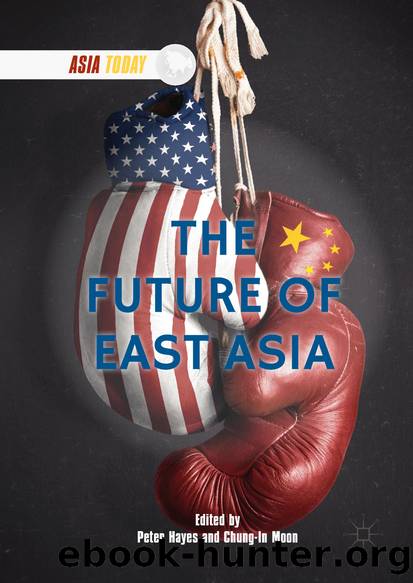
Author:Peter Hayes & Chung-In Moon
Language: eng
Format: epub
Publisher: Springer Singapore, Singapore
Conclusion and Policy Implications
Despite inherent security interests and long-standing territorial conflicts among East Asian economies, we have seen deepening functional integration in a form of soft regionalism, as exemplified in the ever-expanding regional and global value chains. As an important first step toward an East Asian economic community , formal region-wide integration architecture is highly desirable beyond that resulting from an ongoing natural integration process. The concluded TPP agreement now awaits ratification in the twelve founding countries. Another mega free trade deal in Asia, namely the RCEP , was also urged to be concluded in 2016 by the leaders of ASEAN at the 27th ASEAN summit held in November 2015. On top of the two free trade mega-deals, there is Chinaâs initiative for âOne Belt , One Roadâ and the newly formed AIIB , both of which are expected to boost trade and investment links between China and Southeast and Central Asia. Once the three institutions connect and converge, fresh and expanded business opportunities are likely to emerge in East Asia and all of Asia. All stakeholders would welcome these developments to overcome the increasingly structured ânew normal â symptoms such as simultaneous low growth and low employment.
In order to address serious global issues and to successfully pivot towards Asia, the United States needs to find a collaborative strategy with China when it comes to shared goals on climate change, anti-terrorism, trade, foreign investment, intellectual property rights, etc. As former US Secretary of Treasury Lawrence Summers wrote in 2015,29 âThe emergence over the past year of a major Asian trade integration effort (the TPP) in which China does not participate, and a major financial institution (the AIIB) in which the United States does not participate, is hardly auspicious. John Maynard Keynes asserted in The Economic Consequences of the Peace that the primacy of economics, observing the perils of the future, lies not in frontiers and sovereignties but in food, coal, and transport.â
If the United States and China play out a zero-sum game to maximize their own national interests at each otherâs expense by containing or isolating each other, the two separate mega-blocs, TPP and RCEP , are likely to generate an unstable world economic system in terms of trade, investor state disputes, IPR, and exchange rate alignment as contained in the TPP. As a consequence, the full potential effects of the new trade rules of the TPP would not be realized.
Though different in motivations and political consequences, these concerted regional efforts can inject new momentum into the broader and deeper liberalization of trade and investment. If an original ASEAN initiative, RCEP, about which China has been very enthusiastic, is concluded, it would be highly desirable to link it with the TPP . It is evidently clear that without RCEP members, the TPP would not have its desired outcome.
The TPP without China and RCEP without the United States are only partly formed entities. If combined, the two free trade blocs might lead to the realization of an APEC Free Trade Area and ultimately, an East Asian Economic Community .
Download
This site does not store any files on its server. We only index and link to content provided by other sites. Please contact the content providers to delete copyright contents if any and email us, we'll remove relevant links or contents immediately.
| Anthropology | Archaeology |
| Philosophy | Politics & Government |
| Social Sciences | Sociology |
| Women's Studies |
The Secret History by Donna Tartt(19480)
The Social Justice Warrior Handbook by Lisa De Pasquale(12301)
Thirteen Reasons Why by Jay Asher(9135)
This Is How You Lose Her by Junot Diaz(7070)
Weapons of Math Destruction by Cathy O'Neil(6488)
Zero to One by Peter Thiel(5956)
Beartown by Fredrik Backman(5952)
The Myth of the Strong Leader by Archie Brown(5633)
The Fire Next Time by James Baldwin(5597)
How Democracies Die by Steven Levitsky & Daniel Ziblatt(5339)
Promise Me, Dad by Joe Biden(5239)
Stone's Rules by Roger Stone(5197)
A Higher Loyalty: Truth, Lies, and Leadership by James Comey(5092)
100 Deadly Skills by Clint Emerson(5034)
Rise and Kill First by Ronen Bergman(4911)
Secrecy World by Jake Bernstein(4899)
The David Icke Guide to the Global Conspiracy (and how to end it) by David Icke(4857)
The Doomsday Machine by Daniel Ellsberg(4633)
The Farm by Tom Rob Smith(4614)
